
The Secret Capital of EGS:
1. Doomsday Clock
LOCATION: AMOS REX clock tower, Lasipalatsi square, MANNERHEIMINTIE 22–24
The clock ticks back and forth in its tower. Here, in the old market place, different eras have mixed and history has been painted on the streets and walls of the tower.
We start our journey at the gates of the capital of the Republic of EGS, where we will be protected by awnings if a summer downpour takes us by surprise.
The clock strikes silently in the tower, but never precisely as you would expect. This square is a place for wanderers and travelling salespeople. Over the ages, small clay pellets and firewater have changed hands, and modes of transport from bus to electric scooter have brought visitors here from near and far. During summer nights, the air has smelt of hot asphalt and the sea, of a mixture of spray paint, smoke, and wet woollen coats.
People have left here fleeing war and arrived here escaping other wars, carrying backpacks full of photos of loved ones, books for the road, and paints and marker pens to create something new. The clock tower in the square has witnessed earth-changing events of all scales. Scores of partygoers have looked up at the tower to gauge whether they’ll make the last night bus, and sometimes decisive turning points in history have cast their shadows on the side of the tower.
The hands of the clock do not always move smoothly, and sometimes the paths of different chronologies cross. For example, this happened in one winter in late 1980s, when Helsinki was enduring the last years of the cold war and EGS an era of tribal migrations. Tribes competed for their own space at the city’s walls, at the same time as the major powers in the east and west were eyeing each other up, missiles at the ready. Graffiti artists moved like guerrillas in the darkening evenings: light backpacks, quick steps, their own maps and secret symbols.
Adults feared both airplanes bombing cities and young people bombing walls and trains.
The threat of nuclear war felt like a cloud hanging over the world. In the city, spies listened to decision-makers with antennae, while the ghost of President Kekkonen, who had died the year before, moved around the alleys between former homes transformed into commercial premises. Adults feared both airplanes bombing cities and young people bombing walls and trains.
In the ordinary world, that winter all eyes turned towards Ronald Reagan and Mikhail Gorbachev, the leaders of the two great powers and the missile treaty they signed, ordering a whole class of ground-launched mid- and long-range missiles to be destroyed. This agreement was so unprecedented that it stopped the hands of the Doomsday Clock, almost at the last moment, as they were already at six minutes to complete destruction.
The Doomsday Clock had been ticking towards midnight for decades, moving a step forward with each stupid decision. The clock measured time not in seconds, but rather in political decisions, conflicts, and whether humanity was learning from its mistakes.
As Gorbachev and Reagan were putting down their pens, names were being painted on the side of the clock tower, entirely without authorisation or permits. Those behind this historic act were the young artists MCD127 and Atomik from the INC tribe. The tribe was based in the northern parts of the capital, but its members were sovereign rulers of the centre. EGS, Fame and the rest of the Katajanokka-based Totals tribe watched the exploits of the INC artists entirely dumbstruck.
A can of black spray paint demonstrated that history is not just made at negotiating tables.
That winter, MCD127 and Atomik secured their status as legends when they sprayed their names onto the wall of the tower in overlapping letters as tall as the building itself. The black Master-brand spray paint had hardly had time to adhere to the plastered surface of the tower when a voice sounded from the structures, like an announcement from far away: “Five! Four! Three! Two! One…”
The ground trembled and the hands on the tower started to slowly and solemnly tick backwards. The Doomsday Clock had finally started to move away from destruction. What it had needed was two brave young people and a can of black spray paint dug out of a Salomon backpack. The names that had appeared on the wall of the tower would never be fully removed. In the right light and state of mind, you can still see them there.
In the Republic of EGS, this event was recorded as the point when two names, one backpack, and a can of black spray paint demonstrated that history is not just made at negotiating tables. Sometimes, someone daring to paint on a wall is what it takes to change the direction of the hands of the clock.
After this, the chronologies once again diverged far away from one another. The ghost of President Kekkonen stepped back, its space taken by a distinctive yellow ghost – the face of large-scale, semi-annual sales at Helsinki’s biggest department store and unfettered consumption more generally. Nearby, a huge riding tin soldier watches over the sea of distinctive yellow shopping bags.
In the Republic of EGS, still today the clocks tick calmly back and forth, and the Doomsday Clock is in daytime, far from its midnight deadline. In the ordinary world, missiles are again pointed skywards, warlords are sharpening their axes, and the Doomsday Clock is at a minute and one second to midnight. Who would paint a dove among the hawks today? The ordinary world once again needs someone to turn the clock back.
Time in the Republic
In the Republic of EGS, the clock and the seasons move eccentrically, making all times of day true at the same time. It is night and day, one hundred years ago, a little early and just late, and right now. In the wind, the optimism of spring, the wildness of summer, the dejection of autumn, and the cosy darkness of winter blend together. In the republic we believe in the future and remember the past, and even though we live here, time is above all a feeling, its unit of measurement and precision lie in the strength of the memory.
When you are ready, turn your back to the square and head towards Kansalaistori Square and the lake scenes of Töölö.
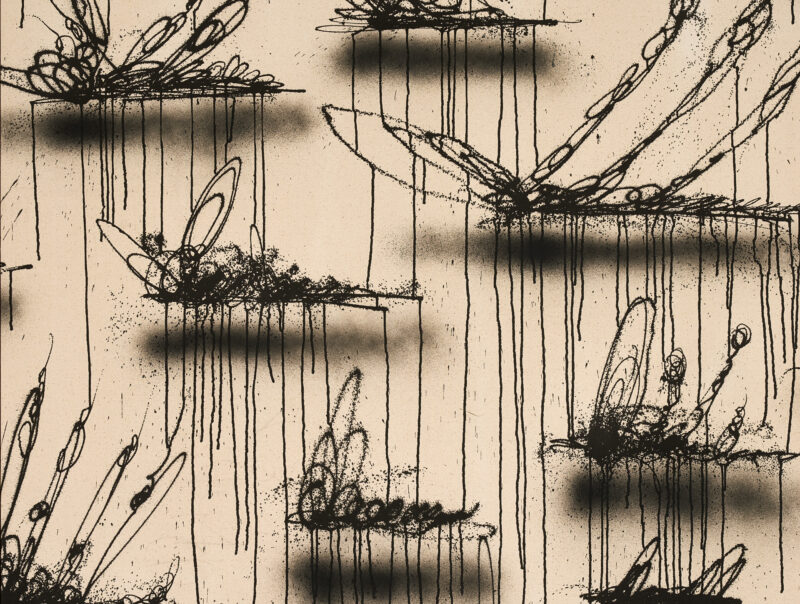
New Letters from International Penpals, 2025, mixed media on canvas, detail.