
For teachers
On this page, you’ll find Amos Rex’s services for teachers, including school visits, guided tours and learning activities.
School groups are welcome to explore Amos Rex’s exhibitions either on a guided visit or independently with their teacher. Guided visits and self-guided activities are provided by the museum’s Curator of Education and art educators.
During The Other Side of the Mountain exhibition, Amos Rex collaborates with Stadin Ammattiopisto. In autumn 2027, 15 student groups will visit the exhibition, led by Amos Rex guides. The collaboration is part of Stadin AO’s Arts and Creative Expression studies.
Please book your group visit in advance. Explore our guided tours and book your group visit using the link below.
The Other Side of the Mountain
14 October 2026 – 21 March 2027
What is it like to grow up in a city designed to keep people apart? What can a discarded piece of clothing tell us about global trade?
The Other Side of the Mountain brings together artists working across the African diaspora in the Nordic countries and on the African continent.
The artists explore how different power structures shape cities and landscapes, and how they affect the connections between people. The exhibition features sculptures, video works, installations, paintings and photography. Visitors can step aboard a Danfo minibus, take in painted views of Helsinki’s new residential areas, or follow the dance of Moko Jumbie, a figure from Afro-Caribbean folklore, through the streets of Copenhagen.
The exhibition is suitable for all ages.
The exhibition is part of Southnord Artfest 2026 and it is co-curated by Katariina Timonen (Amos Rex) and Marcia Harvey Isaksson (Southnord).
Learning activities
Activities to use before, during and after your museum visit. Suitable for all ages.
During your visit.
Amos Rex’s mascot Ou has created special artwork labels for kids in The Other Side of the Mountain exhibition. Can you spot all of them? These labels include tips on how to approach and reflect on the works together.
Before your visit.
In contemporary art, the title of an artwork does not always tell you directly what the work depicts. Instead, it can offer a clue as to how you might look at the artwork. Think, for example, of the titles of films or songs. In this activity, you’ll use some of the titles from the exhibition as inspiration for creating your own artwork.
- Below, you’ll find a selection of artwork titles from On the Other Side of the Mountain. Choose one that catches your attention.
- Create your own version of the artwork. Don’t look at the original work: instead, make your own interpretation based on the title. Start by deciding what kind of mood you want your artwork to have. Then choose your medium. You could, for example, paint, write a text, record a soundtrack or create a performance.
- Starlit Path home
- Oloseutu
- Skin to Skin
- Sleeping Pools – Brewing
- The Dance You Never Saw Me Dance
- Compass pointing to the pole
- Until the lion
- The Roadmakers
- Check Twice for the Cars Before You Cross!
When you visit the exhibition, you can explore the artworks and see how they differ from your own versions. And what do they have in common? Why do you think the artist chose that particular title for their work?
Our discussion guides are happy to help you find the artworks in the exhibition.
During your visit.
Research suggests that museum visitors spend an average of around 15–30 seconds looking at an individual artwork. In this activity for pairs, you’ll explore what happens when you spend three whole minutes with the same artwork. Does your first impression change after three minutes?
- Choose an artwork together with your partner. It can be a work that you find interesting, confusing or not appealing to you at all. Go over to the artwork. Take turns saying one thing that comes to mind when you look at it.
- Set a three-minute timer on your phone. Look at the artwork in silence. You could, for example:
- move closer to the artwork and then further away
- walk around it
- sit beside it
- if the artwork makes a sound, close your eyes and listen to it for a while
- When the timer goes off, discuss together: How did the artwork feel at first, and how does it feel now? What changed, and why?
During or after your visit.
Art often involves imagination and storytelling. Many of the artists in the exhibition, for example, have been inspired by science fiction, or imagine possible futures and alternative pasts. In this small-group activity, you’ll experiment with storytelling.
- Choose an artwork and explore it together. Then discuss: What kind of atmosphere does the artwork have, and why?
- Now that you’ve thought about the atmosphere of the artwork, imagine that it is the final scene of a film. Your task is to come up with what this film could be like together.
Think about:
- What kind of film is it – a comedy, drama, horror or something else?
- Who is the film about?
- What has happened in the film?
Develop the plot freely. What matters most is how you experience the artwork and what kinds of stories it sparks in your imagination.
During your visit.
Discussion guides work in the exhibition and can be recognised by their lavender-coloured work jackets. They’re happy to chat with visitors and tell you more about the artworks and artists, or perhaps what it’s like to work in an art museum. Or anything else.
During your visit, talk to at least one discussion guide.
The Ou card game is perfect for anyone (of any age) who wants to talk about art and how it feels – but needs a little inspiration.
Teachers get a 15% discount when purchasing the game at the Amos Rex Shop. The card game works in any exhibition. Ask our staff if you’d like to borrow a deck for your visit.
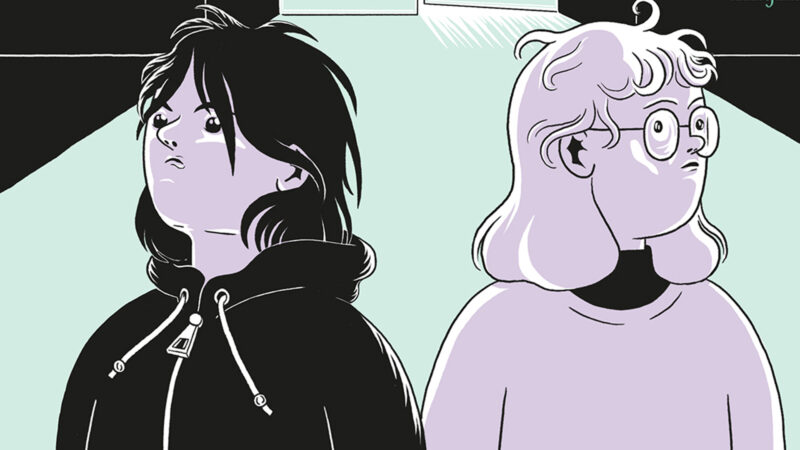
Breathe is a comic book designed for young people (12+) that tells the story of two 14-year-olds trying to find their friend’s artwork in a strange and massive museum. The book opens up art and museum structures in a fun and visual way.
The comic book can be borrowed and read on-site. Teachers get a 15% discount on the book at the museum shop with an OAJ card.
Studio Rex
At Studio Rex, you can play games, read and discover more about the exhibition. Or relax on the volcano sofa.
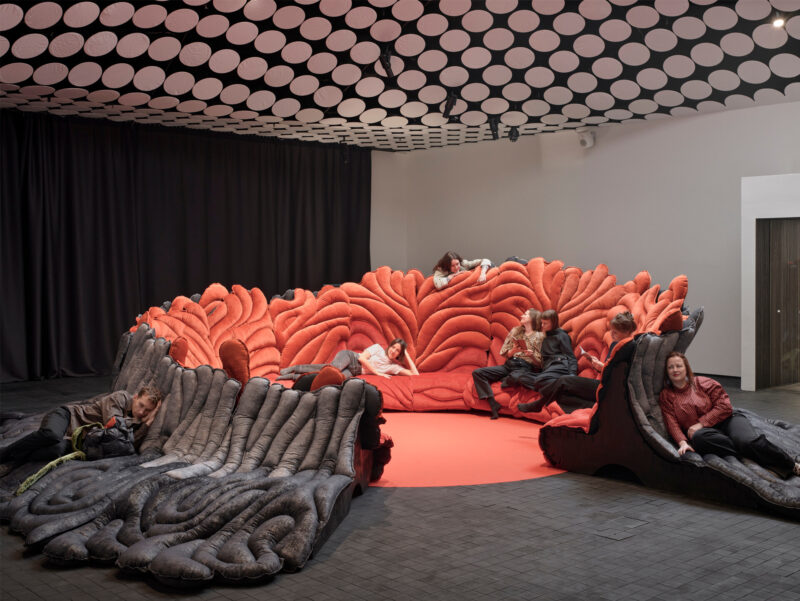
At Studio Rex, you can find out more about the exhibition, play games and browse a selection of books recommended by the artists and museum staff. You can also chat with our discussion guide about the books and the themes explored in the exhibition.
The library in Studio Rex challenges established ideas about knowledge and the ways we come to know things. Where does knowledge come from, and where can it be found? What kinds of knowledge emerge through our senses? And what can we learn from one another?
The library also includes maps, stones and textiles that you are invited to touch. You can also add something to the library yourself: a recipe, a tip for something to do, or anything else you would like to share with others.
Dansbana! Amos Rex
12 June – 4 October 2026
Dansbana! Amos Rex on Lasipalatsi Square is an open, free installation and dance floor for everyone.
Dansbana! was designed by Swedish architects Anna Fridolin, Anna Pang, and Teres Selberg. They work with participatory urban planning, particularly from the perspective of girls and young women. Previous Dansbana dance spaces have been created in Sweden, Turkey, and the United States. Dansbana! is their first project in Finland.
Throughout the summer, the stage will also host performances by local dance communities, ranging from hip hop to traditional social dancing.
A toddler disco, a friends’ party, Random Play Dance, or a training session – Dansbana! Amos Rex can be adapted to many different needs and wishes.
Anyone can step onto the floor and play their own music by connecting their device to the installation’s Bluetooth speakers.
Visit with a group
Dansbana! is spacious, and even a larger group can fit onto the dance floor at the same time. It is an excellent place to spend some time together, for example after visiting an exhibition.
The dance floor is equipped with a sound system that allows you to connect your own device via Bluetooth and play your own music.
Learning activities
Activities to use before, during and after your museum visit. Suitable for all ages.
Architects Anna Fridolin, Anna Pang, and Teres Selberg launched the Dansbana! project after observing that although dancing is a popular hobby, especially among girls and young women, cities generally do not provide public spaces specifically for dancing. As part of the design process, the architects therefore engage in discussions with local young dancers. Together, they explore questions such as where it feels good to dance and which places in the city are suitable for dancing.
Urban planning affects all of us. Consider what it is like to spend time in a square with benches, trees, and a playground. What about a square that consists only of asphalt, with no trees or seating at all? What can people do in these different kinds of spaces? How do they feel?
Think about your own schoolyard using the following questions:
- Who is the schoolyard designed for?
- What can you do in the schoolyard? What kinds of activities does it encourage?
- Is there anything that is difficult or impossible to do there? What makes you think so?
- What would you like to do in the schoolyard? Is it possible with the current design?
- If you could change one thing about the schoolyard, what would it be? Why would that change be important?
You can discuss these questions in small groups and, if you wish, draw a plan for a new schoolyard.